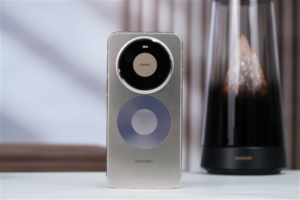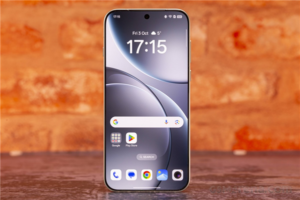
Huawei Mate X7 is fully equipped with HarmonyOS 6: Multi-agent collaboration is commercially available for the first time

Huawei officially unveiled its two flagship series, the Mate 80 and Mate X7. Both new phones come pre-installed with HarmonyOS 6, achieving a deep upgrade in system and application experience while comprehensively upgrading hardware configurations.
Among them, the Huawei Mate X7, as a representative of foldable screen flagships, achieved the first commercial application of Agent to Agent (A2A) intelligent agent collaboration based on HarmonyOS 6. Combined with innovative functions such as split-screen linkage and smart office, it fully released the advantages of the foldable screen form and brought revolutionary experiences to diverse scenarios such as financial management, travel, and office work, once again establishing HarmonyOS AI’s leading position in the industry.
Multi-agent collaboration is being used for the first time in commercial applications: breaking down application barriers and allowing commands to reach all scenarios.
The core breakthrough of this dual-flagship launch lies in the first commercial application of A2A intelligent agent collaboration. The split-screen adaptation of the Huawei Mate X7 on its large screen further enhances efficiency. The Xiaoyi intelligent agent has been upgraded from a single voice assistant to a super service hub that links multiple vertical applications . Users only need a natural language command to have Xiaoyi seamlessly activate dedicated intelligent agents in fields such as finance, travel, entertainment, and fresh food, completing a closed loop from request to service delivery without having to manually switch between multiple applications.
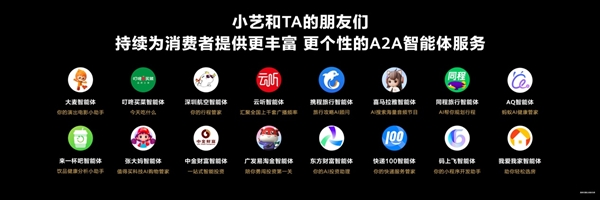
In financial management scenarios, Eastmoney’s “Miaoxiang” intelligent agent, the industry’s first financial intelligent agent listed on the Xiaoyi Intelligent Agent Marketplace, provides investors with a professional-grade voice interaction experience. Users can simply state their needs during their commute, such as inquiring about overnight market dynamics, and the intelligent agent will generate key events and risk alerts for the day based on real-time exchange data and a global macroeconomic database. When encountering unusual stock movements, users can inquire about the underlying reasons for the price increase, and the system can analyze and break down complex market conditions by incorporating factors like capital flows and policy impacts, transforming complex market information into easily understandable conclusions. Furthermore, leveraging the advantages of the Huawei Mate X7’s foldable screen, users can simultaneously monitor the overall market index, sector trends, and intraday transaction details when viewing individual stock details. The HarmonyOS versions of professional applications such as Tonghuashun and Wind Financial Terminal are also compatible, significantly increasing the efficiency of large-screen financial management.
In travel scenarios, Shenzhen Airlines’ Flyfly AI assistant makes air travel services efficient and convenient throughout the entire process. Users can directly complete operations such as booking tickets, changing dates, and checking in and selecting seats through Xiaoyi. When checking in, users can specify their seat preferences, such as a preference for a view seat, and the AI assistant will accurately recommend and complete the operation. In case of flight changes, the system can combine airline data and meteorological models to push official refund and change information and provide travel suggestions in a timely manner, reducing travel uncertainty.
In entertainment and daily life scenarios, the collaboration of intelligent agents is increasingly aligning with users’ actual needs. Himalaya’s Xiaoya intelligent agent supports personalized podcast customization; users only need to specify the duration and content direction to receive accurate recommendations. During playback, users can adjust the content, ask follow-up questions, or request summary notes. Dingdong Maicai’s intelligent agent provides seasonal recipe recommendations, supports one-click addition of ingredients to their cart, and offers cooking tips. Even when searching for niche ingredients, it can provide suggestions based on regional and seasonal factors. Furthermore, intelligent agents for Huawei’s own applications such as video, music, and reading have also been integrated, allowing users to quickly access personalized services through voice commands.
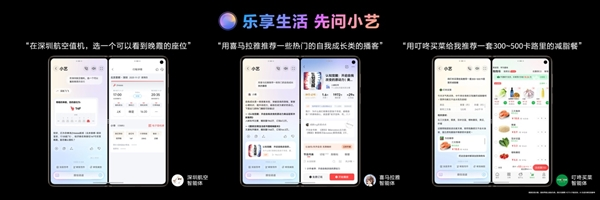
The core of these intelligent agents’ collaboration is the data interoperability and functional linkage between applications achieved by HarmonyOS 6 through a unified protocol, using natural language as the core of interaction to build an efficient and smooth full-scenario service system.
Split-screen interaction + smart office: Transforming the advantages of foldable screens into efficiency benefits
Moreover, the foldable screen form of the Huawei Mate X7 is deeply integrated with the AI capabilities of HarmonyOS 6. Through smart office functions such as split-screen linkage, Xiaoyi Smart Notes, and document comparison, the advantages of the large screen are transformed into actual efficiency improvements, covering high-frequency scenarios such as learning, working, and reading.
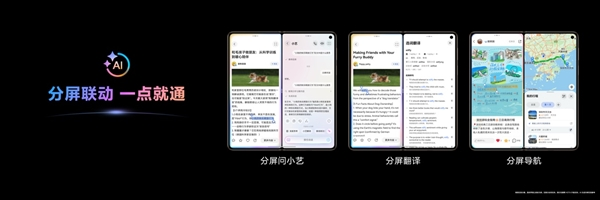
Among these features, split-screen interaction makes multitasking more efficient. When browsing web pages, Xiaoyi can automatically split the screen to perform searches without switching apps; when searching for complex travel guides, Xiaoyi can also integrate travel guides and map services. For example, by selecting location information in a Xiaohongshu note, the itinerary guide and real-time navigation can be displayed in a split screen. Mainstream map applications such as Gaode Map, Baidu Map, and Huaban Map are already compatible; in translation scenarios, selecting foreign language content will display the translation results in a split screen, allowing for immediate translation and improving efficiency.
Xiaoyi Smart Recorder supports AI-powered real-time audio recording and transcription, accurately capturing key content. A single screenshot allows for intelligent annotation of crucial information, precisely addressing the pain points of recording meetings and learning sessions. In online meetings, online classes, or live streams, the system can trigger cross-device reminders when the content mentions the user, ensuring no key information is missed and allowing users to focus more on the core content rather than the recording process.
It’s worth mentioning that Xiaoyi’s document comparison function directly addresses pain points in office work, intelligently analyzing two documents and accurately locating differences in text and data. Whether checking contract terms or comparing medical reports, it can quickly identify changes, improving efficiency several times over compared to manual methods. Combined with the advantages of a foldable screen, it makes the differences even clearer.
In addition, Huawei Reading, in collaboration with several publishers, launched AI-powered dynamic books on the Mate X7, featuring 50 high-quality titles across 11 categories. These books enhance the reading experience through diverse illustrations, further expanding the application scenarios of AI on large screens.
HarmonyOS AI Leads the Industry: Scenario Implementation and Ecosystem Openness Build Core Competitiveness
Of course, the upgraded AI capabilities of the Huawei Mate X7 are inseparable from the continued growth of the HarmonyOS ecosystem and the deep synergy between software and hardware. To date, the number of terminal devices running HarmonyOS 5 and HarmonyOS 6 has exceeded 27 million, providing fertile ground for AI feature innovation. In terms of applications, according to the announcement at the launch event, the HarmonyOS app market currently offers over 300,000 searchable applications and meta-services, with users downloading/updating over 88 million applications daily.
In my view, the combination of Huawei Mate X7 and HarmonyOS 6 is not only a breakthrough in a single product, but also defines the development direction of intelligent experience in the industry. The first commercial application of A2A intelligent agent collaboration has built an open ecosystem model of Xiaoyi plus partners, which not only leverages Huawei’s advantages in system and AI technology, but also integrates the professional capabilities of various vertical applications, enabling AI services to move from single-point intelligence to full-domain collaboration.
HarmonyOS AI’s core competitiveness lies in its deep scenario-based application capabilities and open ecosystem model. Multi-agent collaboration is not simply a matter of piling up functions, but rather a profound reconstruction of users’ real needs—investors’ market analysis, travelers’ itinerary planning, and professionals’ work efficiency improvement—all can be connected through technology to form a closed-loop service. The open ecosystem attracts more partners, and as more vertical domain agents continue to connect, a co-construction and sharing ecosystem will rapidly take shape.
The achievement of 27 million terminal devices proves that this scenario-oriented innovation has gained market recognition. The Huawei Mate X7 breaks down application barriers with multi-agent collaboration, activates the value of the large screen with split-screen interaction, and expands service boundaries with ecosystem collaboration. It not only sets an industry benchmark for foldable screens, but also proves the leading position of HarmonyOS in the field of intelligent interaction.
It is foreseeable that with the growth of the HarmonyOS ecosystem and the evolution of AI technology, HarmonyOS is expected to bring more breakthroughs in AI user experience. The Mate X7, fully equipped with HarmonyOS 6, has already ushered in a new paradigm of AI-powered smart experiences, enabling truly direct command-based smart living.

Kazam is Focused on creating and reporting timely content in technology with a special focus on mobile phone technology. Kazam reports, analyzes, and reviews recent trends, news and rumors in mobile phone technology and provides the best possible insights to enhance your experience and knowledge.