Huawei Mate X7 Hands-on: The Most Powerful Foldable Screen Deserves Its Title
As a mainstay in the foldable screen market, Huawei’s foldable screen products have consistently enjoyed strong sales and a good reputation. On the street, most foldable screens you see are Huawei products. Against this backdrop, it’s particularly interesting to see what new features the Huawei Mate X7 can offer with its large folding design. Let’s take a look at it together in this unboxing video!
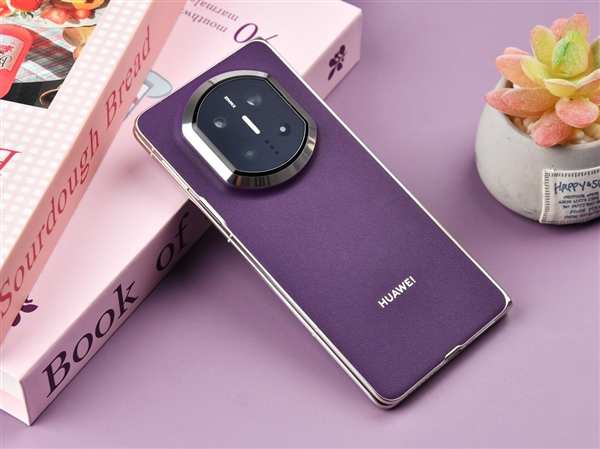
The Huawei Mate X7 Phantom Purple version we tested features a vegan leather material. When your fingers glide across the back, you can feel the delicate texture and a slight damping sensation, making it virtually slip-resistant even after prolonged use. Compared to glass or metal back covers, this vegan leather has a warmer feel and is more suitable for the foldable design, allowing you to hold the external screen with one hand without feeling any discomfort when browsing messages or making calls.
In terms of color options, the Huawei Mate X7 offers five choices: Cloud Brocade White and Cloud Brocade Blue are more artistic, with traditional cloud brocade patterns woven into the back panel using a special process, creating a textured light and shadow effect; Cosmic Red is more vibrant, while Obsidian Black is more stable and understated.
Phantom Purple falls somewhere between flamboyant and understated. If you want your phone to be different from others but don’t want the color to be too flashy, this version will be more to your liking.
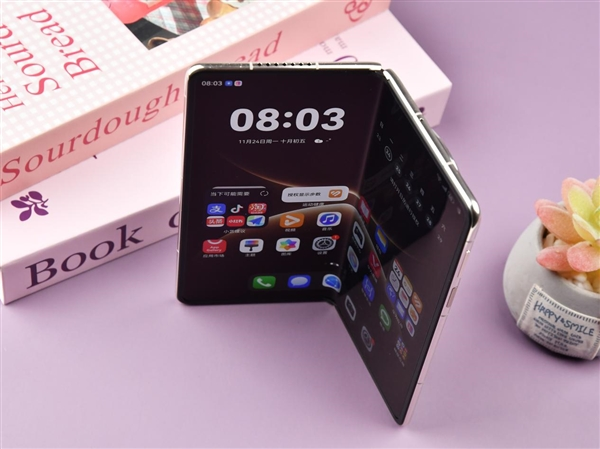
In terms of form factor, the Huawei Mate X7 retains the familiar inward-folding design. When folded, it’s a slightly “slim” candybar phone, and when holding the external screen with one hand, the thumb can easily reach most of the area.
When unfolded, the body is only about 4.5mm thick, giving it a truly “flat” and slim feel when placed flat on a table. Sliding along the mid-frame, you can feel that the transition of the metal frame is quite smooth, and the edges are finely polished, so there is no sharpness when sliding your fingers back and forth on it.
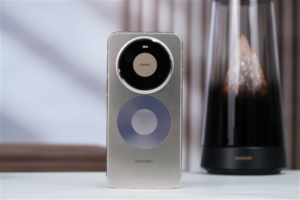
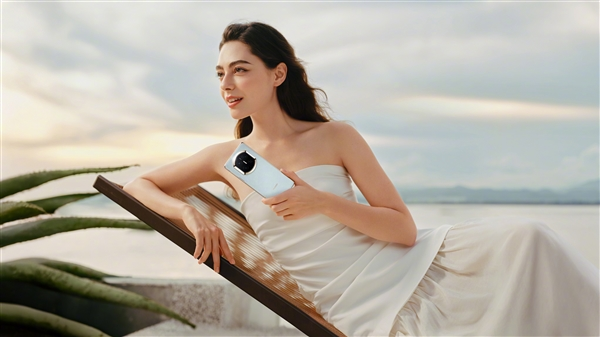
The camera module remains the visual centerpiece of the phone’s back. The circular module is positioned slightly above the central axis of the body, and the transition of different materials and colors around it creates a “door frame” effect. The official description of this design is “a circular window inspired by time and space.” In reality, it feels as if the camera is no longer just a functional module piled on the back, but rather an integral part of the overall design.
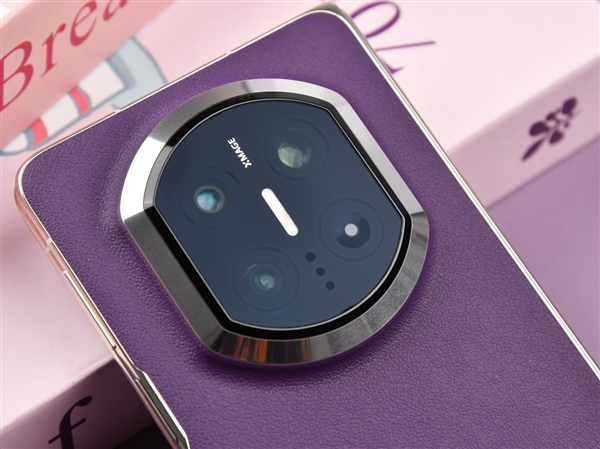
The delicate texture of the Phantom Purple leather back panel contrasts with the highlights around the camera module under natural light, giving the entire device a sense of order without appearing dull when viewed from the back. Combined with its folding design, the rear camera module becomes a focal point whether folded or unfolded, making it instantly recognizable as a Huawei Mate X7.
Whether a foldable phone is good or not depends not only on its appearance, but more importantly on its durability. Huawei has put a lot of effort into the structure of the Mate X7, using second-generation basalt tempered Kunlun glass for the outer screen, which improves its drop and scratch resistance through more refined processing technology.
The inner screen adopts a three-layer composite structure, consisting of a non-Newtonian fluid protective layer similar to automotive cushioning material, a UTG glass layer responsible for pressure resistance, and a carbon fiber layer that provides support, from top to bottom. The overall impact resistance is a step up from the previous generation solution, and the bending resistance is also significantly improved.
The hinge has also been upgraded. The Huawei Mate X7 adopts a new waterdrop-shaped hinge, and the internal core support components use high-strength steel with a strength of 2350 MPa. This allows the screen to form a larger bending radius when folded, thereby reducing creases while ensuring structural strength.
In actual testing, the opening and closing process was quite smooth, and it could stop stably between approximately 40 and 130 degrees. When placed on a table in a half-folded state, it was fine for watching videos, watching short dramas, or making video calls.
After a quick look at the exterior, the first thing I did was, of course, turn it on. The Huawei Mate X7 comes pre-installed with the latest HarmonyOS 6 operating system. The boot animation and boot process were familiar, but the details gave it a more “clean” feel than the previous generation. From language selection and account login to desktop loading, each step was clean, and the accompanying transition animations were controlled at a pace that was just “visible but not sluggish”.
Not only is the system smooth enough, but commonly used third-party applications such as WeChat, Douyin, Meituan and Xiaohongshu also perform well on the Huawei Mate X7, without any sense of “hasty adaptation”.
After using it for a while, I can say with some confidence that, based on my current experience, the compatibility of the HarmonyOS ecosystem has exceeded 95%. Most mainstream applications perform very well, and it also has many unique capabilities that other systems cannot provide for the time being.
If you have some niche tool needs, the Zhuoyitong app in the system can also help you install more less popular but useful apps, thus addressing the question of whether the ecosystem is sufficient from another perspective.

In terms of AI-related experiences, Huawei has also made many attempts for large screens in the Mate X7. HarmonyOS 6 introduces a more complete intelligent agent collaboration mechanism for the first time on this foldable phone. You can summon Xiaoyi with a single sentence to coordinate multiple applications to complete a task at the same time. For example, when planning a weekend trip, it will consider information such as maps, hotels, weather, and itinerary, and integrate the results into a relatively complete solution.
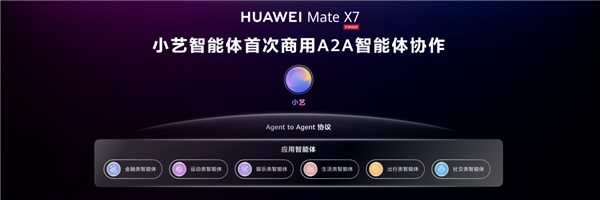
After unfolding the large screen, the multi-window and split-screen gameplay is taken to a new level. You can view documents or web pages on the upper half of the screen while chatting with friends or taking notes on the lower half. This is where features like “Ask Xiaoyi in Split Screen” become very useful. A single voice command can organize the key information on the current screen, saving you the trouble of copying back and forth between different windows.
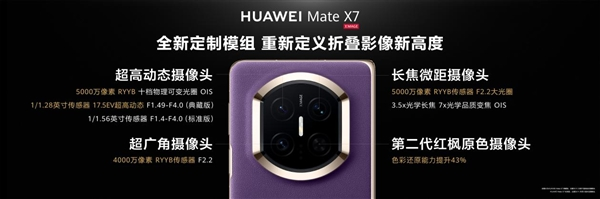
The imaging capabilities are a major focus of the Huawei Mate X7’s upgrade. It features the second-generation Red Maple Imaging System, with a 50MP RYYB sensor as the main camera, boasting a 1/1.28-inch sensor size and a 10-stop physical variable aperture ; the telephoto lens is also a 50MP RYYB sensor, supporting 3.5x optical zoom and equipped with OIS optical image stabilization; and the ultra-wide-angle lens is a 40MP RYYB sensor. Due to time constraints, we will dedicate more time to in-depth analysis of the specifications and sample photos in a later, more comprehensive review.
In terms of communication, in addition to regular network capabilities, the Huawei Mate X7 also supports Tiantong satellite communication, Beidou satellite messaging, Starflash, and emergency communication without network access on the 700MHz band.
In everyday city life, these capabilities may not seem very noticeable, but if you’ve ever experienced poor signal or even no internet at all, you’ll understand why these technologies are considered important. Simply put, they provide an extra means of communication when all other networks fail.
Overall, Huawei has made the folding form factor a real everyday form factor for the Mate X7, rather than a deliberately exaggerated “concept”.
In terms of appearance, the Time Gate design makes the whole device both distinctive and stable; in terms of structure, the more robust screen and hinge design ensures that the device can be “bent and used” in every daily opening and closing; the screen, performance, system and AI experience have been refined in many details around the core of “large screen”, from multi-tasking to intelligent agent collaboration, making you more willing to use it for a while the more you unfold it.
If you were to choose a relatively well-rounded foldable phone that is suitable as your primary device for a long time, the Huawei Mate X7 would certainly be at the top of the shortlist.

Kazam is Focused on creating and reporting timely content in technology with a special focus on mobile phone technology. Kazam reports, analyzes, and reviews recent trends, news and rumors in mobile phone technology and provides the best possible insights to enhance your experience and knowledge.