How does the iPhone 17e perform after the significant reduction in core count? Real-world performance test.
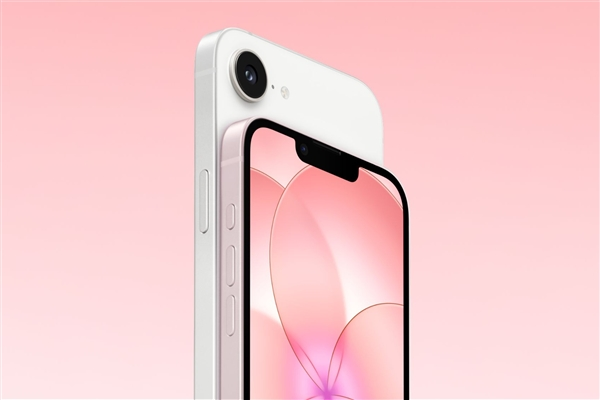
When Apple unveils the iPhone 17e at its spring 2026 event, this mid-range model quickly becomes the focus of public attention.
The A19 chip it features has reduced the number of GPU cores from 5 in the standard version to 4. This “precise reduction” has raised questions among consumers about its performance: Does a reduction in the number of cores mean a downgrade in the user experience? This article provides an in-depth analysis of the iPhone 17e’s actual performance after the reduction in the number of cores through benchmark tests, game performance tests, and other dimensions.
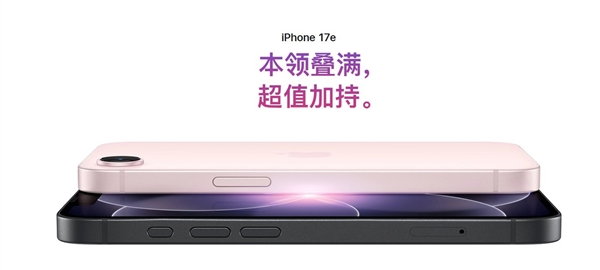
Chip Architecture: An Energy Efficiency Revolution Under TSMC’s 3nm Process
The A19 chip in the iPhone 17e uses TSMC’s third-generation 3nm process, which is key to its balance between performance and energy efficiency. The chip integrates a 6-core CPU (2 performance cores + 4 efficiency cores) and a 4-core GPU, and features a 16-core Neural Engine that supports hardware-accelerated ray tracing. This is despite having one fewer GPU core than the standard version.

Geekbench 6 test data shows that the iPhone 17e’s CPU single-core score is 3533 points and its multi-core score is 8874 points, which is less than 5% lower than the standard iPhone 17.
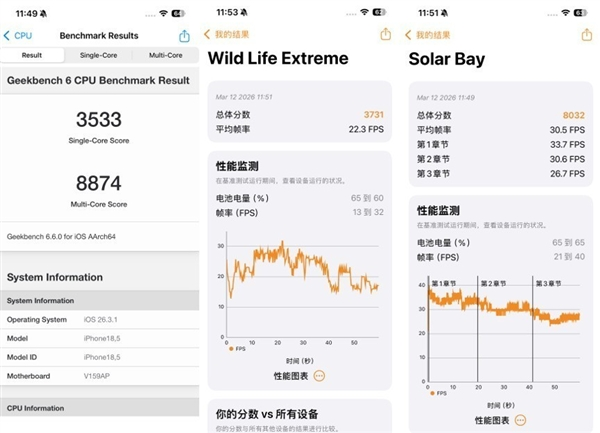
The reduction in the number of GPU cores is directly reflected in graphics processing capabilities. Wild Life EXTREME, which focuses on 3D performance, and SolarBay, which focuses on ray tracing performance, achieved scores of 3731 and 8032 respectively, which are slightly worse than the iPhone 17 by 15-20%, with the difference of having one less GPU core being relatively significant.
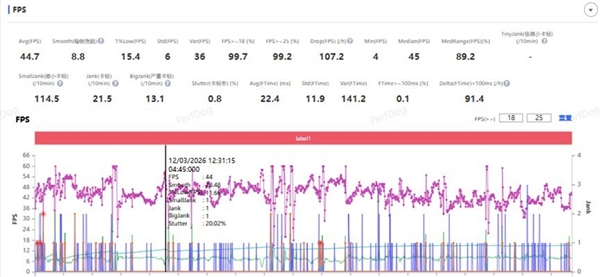
In terms of gaming, we chose the “Golden Moment” mode in “Honkai Impact: Star Railway” for a map run test. The test lasted for 30 minutes, with the graphics settings set to very high + 60 frames per second. The average frame rate was 44.7 frames per second. After the 30-minute test, the highest body temperature was 48.1 degrees Celsius, and the frame was still a bit hot to the touch.
Furthermore, the iPhone 17e is Apple’s first mid-range model to explicitly support Apple Intelligence. Its 8GB of RAM provides a foundation for AI features such as real-time voice translation, intelligent photo editing, and Siri suggestions. In the camera interface, the new portrait mode can automatically recognize people and pets and supports post-processing adjustments to the background blur level. This feature relies on the A19 chip’s Neural Engine for real-time calculations.
Summarize
Despite having one fewer GPU core, the iPhone 17e still achieves a balance between consistent CPU performance, sufficient GPU performance, and improved battery life. For most users, the iPhone 17e’s performance is sufficient for the next 1-2 years, while the addition of ecosystem features such as MagSafe and Apple Intelligence further strengthens its position as a “mid-range flagship.”
In an era of smartphone performance overkill, the choice of the iPhone 17e may represent a new trend: rather than pursuing the ultimate in specifications, it is better to achieve a balance between experience and cost through precise product segmentation.

Kazam is Focused on creating and reporting timely content in technology with a special focus on mobile phone technology. Kazam reports, analyzes, and reviews recent trends, news and rumors in mobile phone technology and provides the best possible insights to enhance your experience and knowledge.