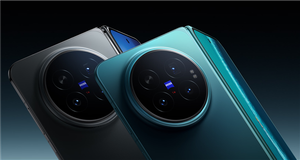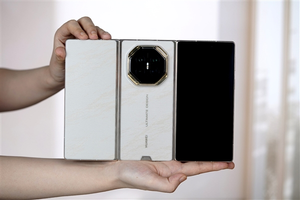
Xiaomi’s three self-developed technologies have finally closed the loop. Just how powerful is the MIX Fold 5?
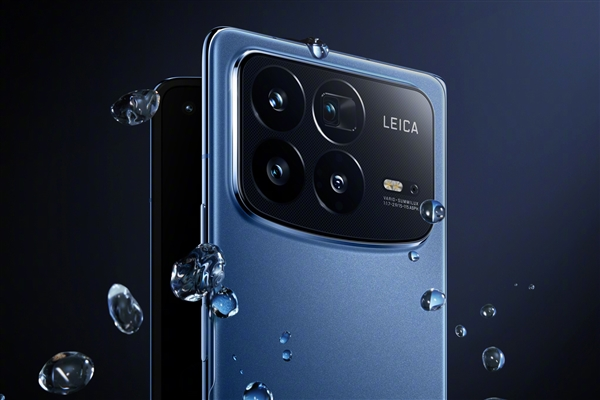
When Lei Jun announced at the investor day that the Xuanjie O1 chip had shipped over one million units, the reaction in the comments section was quite interesting—the most upvoted comment wasn’t congratulations, but rather, “So, will the MIX 5 still be released?” Mi Fans’ mentality is very real. The data for their self-developed chip is indeed impressive, but what everyone really wants to know is when these technologies will be applied to a truly exciting product.
Why are there so many conflicting reports about the MIX 5?
This all started with a leak a few days ago. Some media outlets discovered a new phone codenamed “hongkong” in Xiaomi’s database, with the internal model number Q5.
Following Xiaomi’s naming convention, the number 5 has always belonged to the MIX series—D5 for the MIX 2, D5X for the MIX 2S, and E5 for the MIX 3, making the logical chain seem complete. As soon as the news broke, Mi fans were ecstatic, with speculations about under-display front cameras, magnetic lenses, and the return of true full-screen displays reaching unprecedented levels.
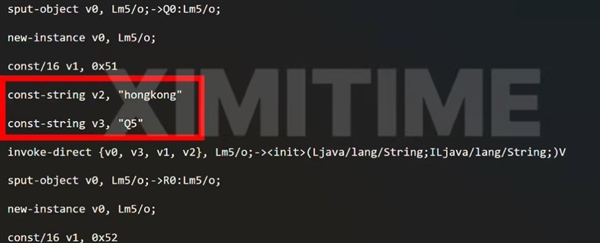
However, other bloggers poured cold water on the idea that same day: the Q5 belongs to the Xiaomi 18 series, not the MIX 5. The much-discussed mass production plan for the magnetic lens has also been temporarily shelved.
To be honest, Xiaomi did have plans to develop the MIX 5. Late last year, there were leaks mentioning that Xiaomi had started a special project featuring a quad-curved screen and an under-display front camera – a design clearly in line with the MIX series’ flagship smartphone. However, there was no new information about this project for a long time, and a few days ago, it was reported that it had returned to the lab – mass production plans were shelved.
The reason is not hard to understand. The cost of memory chips and SoC chips has risen outrageously this year, with DRAM contract prices increasing by more than 40% for two consecutive quarters. Under such circumstances, mobile phone manufacturers are hesitant to launch models with uncertain sales volumes. The MIX series was originally a product line designed to showcase strength, not to achieve high sales volume, but the soaring costs have made showcasing strength more expensive.
Xuanjie O3: The traditional large core has been eliminated, and the architectural approach has become more radical.
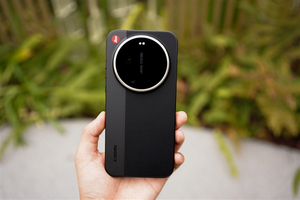
While the MIX flagship foldable phone is out of the question for now, Xiaomi has given the debut of its self-developed technology to another product – the MIX Fold 5 foldable screen phone. This device, internally codenamed Q18 and codenamed lhasa, is tentatively scheduled to be unveiled in July or August this year, and its main feature is its wide folding ratio.
The most noteworthy aspect is the O3 chip it will be equipped with. Parameters unearthed from the Mi Code database show that the O3’s architecture is significantly different from the O1—it directly abandons the traditional Big energy-efficient large core cluster and instead adopts a three-cluster design of a super-large core Prime Core + Titanium Core + super energy-efficient Little Core.
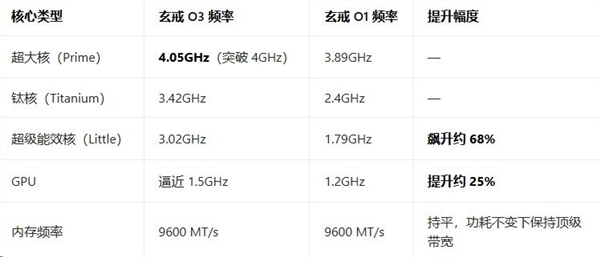
The super core frequency has exceeded 4.05GHz, and the energy efficiency core has reached 3.02GHz. This architecture choice is quite bold. The traditional Android SoC’s quad-cluster solution (1 big core + 3 performance cores + 4 energy efficiency cores, etc.) has been used for many years. Xiaomi directly cut off the middle performance big core layer and concentrated resources at both ends – either running performance at full speed or extremely power saving.
The impact of this design on daily use is quite obvious: when cold-starting an app, the super cores are fully utilized, resulting in fast response times; when WeChat and music are running in the background, the energy-efficient cores take over, keeping power consumption lower. As for the manufacturing process, there is no definite information yet, but considering that the O1 already uses TSMC’s N3E, the O3 is unlikely to be a step backward.
MiMo V2.5: The top open-source model; its value deserves detailed discussion.
Beyond chips, Xiaomi is likely progressing faster than many anticipated in its AI big data model development. It released three models in the Mi Mo V2 series in March, and then launched the V2.5 series on April 23rd—only a month later.
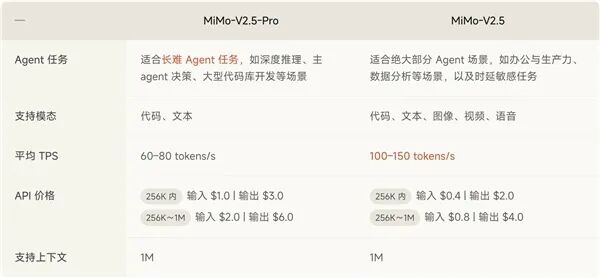
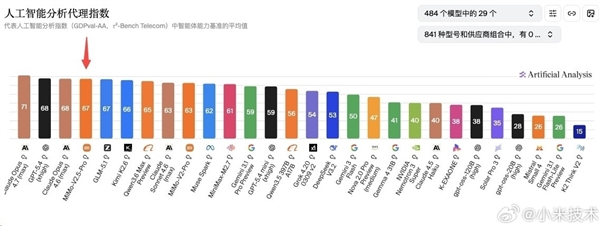
MiMo V2.5-Pro boasts a parameter scale reaching trillions, with a MoE architecture comprising 1.02 trillion total parameters and 42 billion active parameters. It holds the top spot in the global AA large model rankings for open-source large models. Even compared to closed-source giants like Gemini, GPT, and Claude, it ranks among the top five globally.
One technical detail illustrates the actual capabilities of this model. During the public beta testing, Xiaomi demonstrated that the MiMo V2.5-Pro completed a SysY compiler from scratch in 4.3 hours and through 672 tool calls—a course project that typically takes Peking University undergraduates several weeks to complete.
All 233 test cases in the hidden test set passed, and the first-time cold start pass rate was 59%. Even more interestingly, in round 512, the model itself diagnosed a code rollback caused by a refactoring and proceeded while fixing it.
Xiaomi chose the MIT license for complete open source and also adapted it to multiple domestic inference chips such as Pingtouge, Kunlun Chip, and Muxi. The intention behind this move is clear—not to make money from the model itself, but to attract developers through the ecosystem, ultimately benefiting the AI experience on its own devices.
miclaw and Vela: The capillaries of every device crammed with large models
No matter how powerful a large model is, if it only exists at the cloud API level, the impact on ordinary users is limited. Xiaomi’s approach is to use miclaw, an on-device AI assistant, to extend the capabilities of the MiMo model to mobile phones, tablets, PCs, and even speakers with screens.
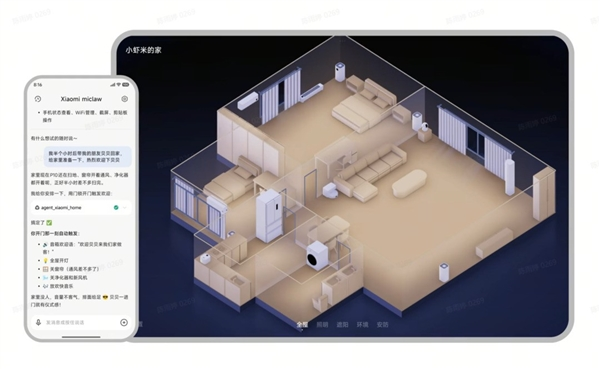
Unlike the simple question-and-answer interaction of Xiao Ai (Xiaomi’s AI assistant), miclaw can understand user intent and break down task steps itself. For example, if you say “send me a file from my computer” on your phone while you’re out, the mobile version of miclaw will call the PC version and transfer the file. If you say “turn on the air conditioner, set the temperature to 26 degrees” on your PC, the Mi Home air conditioner will start working immediately.
More importantly, miclaw on mobile phones, tablets, and PCs shares the same memory – logging into the same account, you only need to raise and train shrimp once, and you don’t need to start over when switching devices. This design concept is simply to turn the large model into a cross-device central nervous system, with each terminal becoming its hands and feet.
Underlying this system is Xiaomi’s self-developed Vela operating system. Vela is a lightweight OS designed for IoT devices, requiring only 8KB of memory to run. Currently, openVela supports over 1,500 product categories and more than 160 million devices. From small Bluetooth modules to large smart speakers with screens, everything can be equipped with Vela. Phones and tablets running Surge OS have Vela components integrated into their underlying architecture, naturally enabling them to interconnect with these IoT devices.
Rust Refactoring System: A Long-Term Project to Clean Up Mountains of Terrible Code
Judging from its current actions, Xiaomi’s so-called self-developed system does not seem to be about creating a new operating system and an application ecosystem from scratch. A more pragmatic approach is to gradually refactor some of the underlying frameworks and system apps using the Rust language, while simultaneously integrating the capabilities of the MiMo big model into the system’s underlying layer.
System apps like the photo album, weather app, and file manager have started to be Rust-ized. From MIUI 1 to Surge OS 3, Xiaomi’s system has accumulated a rather bloated amount of code, with various redundant code, deprecated interfaces, and chaotic development languages piled up, affecting both stability and smoothness—users who have used MIUI 12 should know this all too well.
Rust’s advantages in runtime efficiency, memory safety, and cross-platform compilation have been repeatedly proven by major companies. Apple’s iOS has been using Rust to improve system components since last year, and the proportion of Rust code in Google’s Android is also increasing year by year. Xiaomi’s decision to follow this path is largely uncontroversial.
With over a million self-developed chips shipped, ranking among the top five globally in open-source large-scale models, and its self-developed OS covering hundreds of millions of devices—any one of these metrics alone makes Xiaomi’s technological prowess impressive. However, whether these capabilities can truly form a closed loop depends on the user experience when they are combined.
As the first product from the three major self-developed technologies, the MIX Fold 5’s debut in August marked the moment of its completion.

Kazam is Focused on creating and reporting timely content in technology with a special focus on mobile phone technology. Kazam reports, analyzes, and reviews recent trends, news and rumors in mobile phone technology and provides the best possible insights to enhance your experience and knowledge.