The first AI phone was rejected by half of the internet industry.
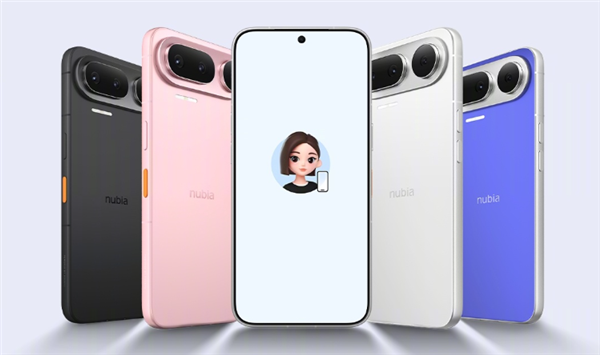
Doubao Mobile Assistant’s “Screen Automation Execution Protocol” (SAEP) officially ended its 30-day public comment period. The subsequently released rejection list shows that 155 third-party applications have explicitly closed the door to AI-powered automated operations. The list was updated twice that day, initially containing 153 applications, and ultimately totaling 155 after supplementing long-tail applications.
The list includes 66 products from Tencent, 23 from Alibaba, 11 from Meituan, and 14 from Kuaishou, covering almost half of the mainstream products in the domestic internet industry. Even similar products in the AI field, such as Kimi and DeepSeek, have chosen to disable permissions.
This long list of rejections marks the first time that super apps have collectively expressed their stance on application boundaries and traffic sovereignty in the era of AI Agents.
As AI begins to be able to tap the screen for users and complete tasks across applications, new cracks are appearing in the mobile traffic landscape and business logic that have been stable for more than a decade.
SAEP: Put the rules on the table
Before the introduction of SAEP, this matter remained in a gray area within the industry.
Whether a mobile AI assistant can operate a certain application, and to what extent, is basically determined by the AI manufacturer’s unilateral technical adaptation. The application provider has no official channel to express its opinion and mostly silently blocks it through risk control strategies. Users, on the other hand, always face vague functional boundaries and do not know why some applications can be operated by AI while others cannot.
The core of SAEP is to return the power to choose screen automation operations to third-party developers.
Developers can independently declare whether Doubao Mobile Assistant is allowed to perform operations such as screen recognition, simulated clicks, and content entry within its own application, and can also refine the permission boundaries to specific pages and functions.
According to the operating rules published by Doubao, the entire access granting process is divided into two phases:
During the 30-day public comment period, all third-party applications will not enable AI operations by default, and only applications that actively declare their consent will be supported. After the public comment period ends, applications that have not explicitly submitted a rejection statement will have their operation permissions gradually opened according to their risk level. Applications that have explicitly rejected AI operations will never be automated by AI, and developers can adjust their declaration status at any time.
From a technical perspective, Doubao Mobile Assistant’s automation capabilities are based on system-level permissions, allowing it to perform screen reading and interactive operations in the background, unlike ordinary accessibility tools which require foreground access. Furthermore, this permission only applies to AI-automated operations and does not affect the normal use of the application itself; users can still manually open and use all apps.
From implicit conflicts to explicit rules
In fact, the introduction of these rules had been foreshadowed beforehand.
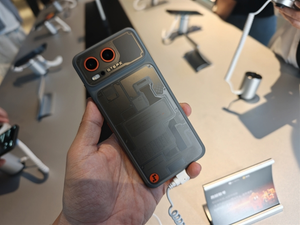
In December 2025, ByteDance, in collaboration with ZTE and Nubia, launched a preview version of Doubao Mobile Assistant, which was installed on the engineering prototype Nubia M153 and made available for industry professionals to experience.
This marked the first time Doubao’s screen automation capabilities were publicly available, but it quickly revealed compatibility issues with third-party applications. Users reported login problems, frequent human verification prompts, and crashes in several mainstream applications, including WeChat, Taobao, Xianyu, and Damai. In competitive gaming scenarios, the automation capabilities also triggered risk control measures from the application developers.
In response to this situation, Doubao officially issued a feature adjustment announcement, proactively restricting the AI’s automatic operation in scenarios such as score-boosting incentive applications, financial applications, and competitive games. The conflict was temporarily suppressed, but no unified solution was established.
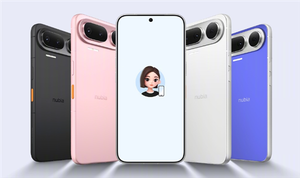
On September 14, 2026, the consumer version of Doubao Mobile Assistant was officially released, along with the “Screen Automation Operation Declaration Protocol” (SAEP), which began a 30-day public comment period. Two days later, the Nubia NaviX Ultra, equipped with the consumer version of Doubao Mobile Assistant, was officially launched, marking the official opening of this system-level AI automation capability to ordinary consumers.
However, less than two weeks after the official implementation, conflicts broke out again.
Starting September 24, numerous users reported that when logging into “Honor of Kings” on NaviX Ultra, they encountered an “abnormal device environment” error, resulting in their accounts being forcibly logged out or even temporarily banned, with the reason being “using third-party auxiliary tools”.
The following day, Doubao issued an apology, stating that after investigation, the assistant did not perform any operations on the game system and there was no illegal simulation behavior. The team was communicating with Tencent. Subsequent media tests showed that even without enabling the GUI automation function, running the game on this model still triggered risk control measures.
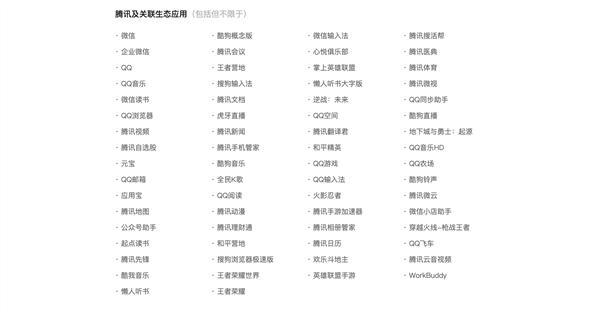
Tencent’s Rejection List | Image Source: Doubao Mobile Assistant Official Website
This incident exemplifies the previous state of conflict: the conflict was real, but both sides were engaged in a covert game of technology and risk control, lacking publicly available rules and clear communication channels. The launch of SAEP attempts to transform this covert game into open rule negotiation.
The factional divisions on the rejection list
The 155 apps that were explicitly rejected cover multiple core areas such as social networking, e-commerce, payment, entertainment, and AI tools, with products from leading internet companies forming the main body of the rejection group.
The majority of those refusing access are leading platforms with complete proprietary ecosystems and closed-loop traffic systems. Tencent has the most products refusing access, with 66 products, covering social portals such as WeChat, WeChat Work, and QQ; office tools such as Tencent Meeting and Tencent Docs; and entertainment products such as Kugou Music and Honor of Kings, with almost all permissions closed.
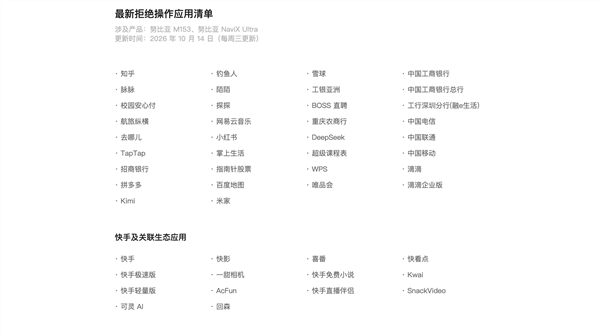
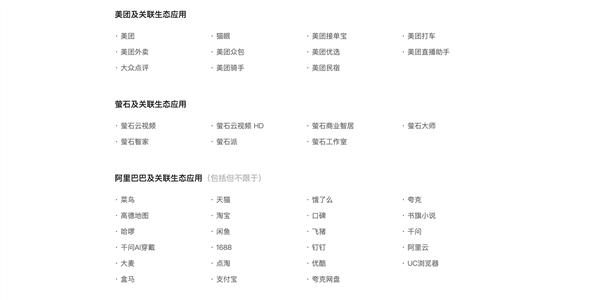
Meituan and Alibaba Group’s rejection lists | Image source: Doubao Mobile Assistant official website
A total of 23 apps from Alibaba Group are on the list, including mainstream products such as Cainiao, Gaode Maps, Tmall, Taobao, Xianyu, Alipay, and Ele.me, basically covering Alibaba’s core app matrix. In addition, 11 apps from Meituan and 14 apps from Kuaishou also declined.
In addition, similar products from several other AI companies were also on the rejection list, including Kimi and DeepSeek. Other third-party applications included Didi, Xiaohongshu, Pinduoduo, Zhihu, Momo, NetEase Cloud Music, Baidu Maps, WPS, Vipshop, as well as the apps of the three major telecom operators, ICBC, and China Merchants Bank, all of which explicitly rejected the application.
On the other hand, many leading applications in various fields have not yet appeared on this rejection list.
ByteDance’s self-developed and related applications are fully supported by default as part of its own ecosystem; in the e-commerce sector, none of JD.com’s products are included.
Similar patterns are emerging in sectors such as long-form video, automobiles, and finance: iQiyi, Mango TV, and Bilibili are not yet on the rejection list; official car control apps from major automakers such as BYD, NIO, XPeng, and Li Auto are all absent; and most state-owned banks and leading securities firms have not yet submitted rejection statements, except for a few institutions such as ICBC and China Merchants Bank.
Overall, the boundary between rejection and acceptance roughly follows the line of “whether or not a platform has an independent traffic entry point and a closed-loop ecosystem.” The more a platform relies on its own homepage traffic and values the time users spend on the site, the stronger its tendency to reject; the more a platform relies on external order distribution and values transaction completion, the more it tends to observe or even open up.
Boundary rights confirmation has only just begun.
This collective choice is not just a game of commercial interests, but also reflects the industry’s shared concerns about safety and responsibility.
Prior to this, the power structure on mobile devices was clear: the operating system controlled the underlying capabilities, apps controlled the service entry points, and users obtained services through apps. The emergence of AI assistants has inserted a new layer between users and apps, disrupting the original balance.
Safety and responsibility are practical considerations.
The ability to read screens and simulate clicks inherently operates in a gray area of compliance. In high-risk scenarios such as payments, logins, content publishing, and information deletion, if AI performs these actions on behalf of users, and issues arise such as fraudulent transactions, accidental payments, or account irregularities, there are currently no clear standards or definitions within the industry regarding who should bear the responsibility: the AI vendor, the app platform, or the user. Many banks and social media applications’ risk control systems already classify simulated operations as plug-ins or risky behavior, and their refusal to allow AI operations stems from practical considerations of security and compliance.
This is precisely why SAEP is far more significant than just a list of authorizations; it brings to light the contradictions that were previously hidden behind risk control. It establishes a transparent set of rules that allows developers to make clear statements and users to have clear expectations.
In the long run, the mobile AI ecosystem is unlikely to develop into a chaotic free-for-all where “whoever has the most privileges wins.” It will likely evolve into a three-tiered game: the operating system determines how many system-level capabilities are granted to the AI assistant, app developers determine the operational boundaries, and users ultimately choose whether to use it and which AI tool to use.
The rejection by 155 apps is just the beginning of this process. It first returns the choice to the developers. The subsequent refinement of permissions, division of responsibilities, and distribution of benefits will require the entire industry to gradually find a balance through negotiation.

Kazam is Focused on creating and reporting timely content in technology with a special focus on mobile phone technology. Kazam reports, analyzes, and reviews recent trends, news and rumors in mobile phone technology and provides the best possible insights to enhance your experience and knowledge.